




Silhouettes profiles Bill Weber
 August 11, 2026 |
  Author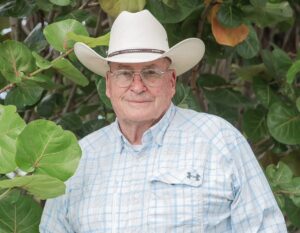
Bill Weber
By Tiffany Razzano
Published July 24, 2026
For more than four decades, Bill Weber has built a career around mobility and independence.
Since opening his Tampa-area business in the early 1980s, Weber has helped many people —from aging adults to injured veterans and people living with disabilities—find the wheelchairs, scooters and wheelchair-accessible vehicles that allow them to continue working, traveling and living on their own terms.
“It’s a very interesting area to be involved with,” Weber said. “We get someone who has limited arm strength and foot strength, and they basically can drive a vehicle just like you.”
Now 88 and living in Temple Terrace, he still works every day, alongside his daughter at the family business, where he has watched mobility technology evolve dramatically over the course of his career.
Born at Tampa Municipal Hospital in 1938, his family moved to Fort Myers when he was just six weeks old, and that’s where he spent most of his childhood. His father owned and operated a restaurant and hotel before being drafted during World War II and serving as a fire chief at Buckingham Army Air Base in Fort Myers.
Growing up in Southwest Florida, Weber excelled in football and track, eventually earning a football scholarship to the University of Southern Mississippi. He played on the school’s 1958 national championship football team before graduating and joining the Air National Guard after receiving an Army commission through ROTC.
His introduction to the mobility industry came almost by chance.
In 1970, Weber accepted a job with Everest & Jennings, one of the nation’s leading manufacturers of wheelchairs and durable medical equipment. Based in Tampa, he oversaw the Southeast territory, which stretched across Florida, parts of Georgia and Alabama, Puerto Rico and the Virgin Islands.
After spending more than a decade learning the business, Weber launched his own company in Tampa in 1983.
What began as a durable medical equipment business eventually expanded into wheelchair-accessible transportation after Weber recognized that many people weren’t receiving solutions tailored to their needs. “There was not anybody here who was paying attention to the people who were using wheelchairs and vans,” he said.
Rather than simply selling products, he tried to understand how each customer lived and what would help them remain independent. “We try to listen to the individuals that are in here,” he said.
That customer-first approach positioned his company to grow alongside advances in adaptive transportation.
During the 1990s, Weber and his daughter traveled to Indiana to train with Braun Corporation, one of the industry’s pioneers in wheelchair-accessible vehicle conversions.
When he first entered the industry, most wheelchair-accessible vehicles were large conversion vans. Over time, manufacturers shifted toward modified minivans, which were easier to drive, park and fuel. He adapted his business alongside those changes, first working on Ford Econoline vans before eventually becoming a dealer for Braun’s wheelchair-accessible Chrysler, Toyota and Honda minivans. Today, he estimates about 96 percent of the company’s vehicle business involves minivans.
One of Weber’s favorite parts of the business is helping customers by outfitting their vehicles with advanced electronic driving systems that allow people with significant physical disabilities to safely operate their own vehicles.
Using customized controls, individuals with limited mobility can steer, accelerate and brake independently, often allowing them to get behind the wheel again after they believed they’d never drive again. “They’re probably safer than we are because they’re cognitive of their disability and their limitations,” Weber said.
The business has long been a family operation. His daughter, Allison Weber, joined the company after graduating from the University of Miami in 1992 and has worked beside her father ever since.
“I couldn’t do anything without her,” Weber said. “I’m able to work with my little girl every day.”
His son-in-law later joined the business as well, while his older daughter, Wendy Weber Allen, pursued a career as a registered nurse specializing in medically complex pediatric patients.
Away from work, Weber spent more than five decades living on a farm in Riverview, where weekends often revolved around livestock, fence repairs and local rodeos. “Billy’s a cowboy at heart,” he said.
When neighboring farmland gave way to residential development, he and his wife moved to Temple Terrace two years ago. This marked the end of an era, where, for decades, he spent his weekends working on the farm – repairing fences and other structures, caring for animals, and sometimes heading to local rodeos with friends.
Although he enjoys his new Temple Terrace community, he still misses the open space and slower pace of country living. “It’s not the farm,” he said.
Even at 88, he still continues to work and get out there in the community. Recently, Weber shared some of the lessons he’s learned from his career during a presentation to a local Rotary Club, encouraging older adults to embrace mobility devices when they need them instead of viewing them as a loss of independence.
Thanks to advances in medicine and mobility technology, people are living longer and staying active later in life than ever before, Weber said.
He’s also been facing his own health battles in recent years, but hasn’t let that slow him down. Even while undergoing treatment over the past year for prostate cancer, he has continued working every day and remains focused on helping customers rather. “I’m healthy. I feel good,” he said. “I work every day, and I’m very blessed.”
After more than 40 years in the mobility business, Weber says the reason he keeps showing up is the same reason he started: helping people maintain their independence.
 Posted in Silhouettes