




Author Archive
Silhouettes profiles Bob Gilbertson
 December 18, 2024 |
  Author
Bob Gilbertson
By Tiffany Razzano
Bob Gilbertson knew from an early age exactly what he wanted to do for a living – he wanted to work for the YMCA. And that’s exactly what he went on to do, working to develop YMCA locations across the country.
He was recently honored by the Tampa Metropolitan Area YMCA at its annual Community Impact Celebration with its prestigious Red Triangle Award.
Growing up in Knoxville, Tennessee, he spent much of his time after school and during the summer at his local Y. “It’s maybe a little unusual … but I had developed relationships with these counselors and coaches,” Gilbertson said. “I developed this real affection for all the time and things that I did at the YMCA. I thought by the time I was 11, this is what I wanted my life to be about, coaching and teaching at the Y. The Y was always the place that I felt most at home and most supported.”
As a teenager, he was hired as a camp counselor and coach at his local Y, working with youth groups. After high school, he went on to the University of Tennessee, where he worked with the swim team.
After two years at UT, he was ready for something new and moved on to George Williams College in Chicago. The college, which was affiliated with the YMCA, offered an exercise science program that focused on topics such as anatomy, physiology and microbiology, and offered studying of human cadavers and live animal experiments. “It was a unique clinical experience that I couldn’t get in any other places,” he said.
Following his graduation from college in 1974, Gilbertson worked for the YMCA in Frankfort, Kentucky, for two years. There, he coached gymnastics and swimming, and ran other programs. He also continued his interest in exercise science through “exercise testing with an old boxing-style EKG machine.” This was around the time there was a push for running and aerobics. “It was a fascinating time when people were saying to exercise to prevent heart disease,” he said. “It was an exciting time to be part of the whole wellness movement. It was just as the stage of taking off. To incorporate that into the YMCA was an exciting time in terms of using education and the momentum to advance health and fitness.”
From Frankfort, Gilbertson moved on to Spartanburg, South Carolina, where he worked with “a bigger community and a bigger Y environment.” He continued to work in moving the wellness movement forward at the facility, including working with a local hospital physician who encouraged his patients in his cardiac rehab to continue their efforts at the local YMCA. “It was one of only a dozen places in the U.S. where people did that and we monitored it,” he said. “The hospital there didn’t have (a gym). This was their community clinic, if you will, at the YMCA.”
Gilbertson came to the Tampa YMCA in 1981, which at the time operated an older YMCA built in 1908 that had a hotel and a gym attached to it. “There hadn’t been a lot done to it since 1908 by the time I got there,” he said.
There were also satellite branches throughout the region. “The foundation of the Y was pretty shaky,” he said.
It was financially difficult to maintain and was only kept afloat because of a benefactor on Sanibel Island. The owner of Bailey’s General Store there owned multiple properties and after his death, left a dozen lots to the Tampa YMCA. Every time the organization needed money, it would sell off one of the properties.
“It’s completely different today,” said Gilbertson, who moved to Tampa as director of operations. “The idea was that I was an executive who would raise money and I would operate the Y. We had centers and the very beginnings of an after-school program, which grew to be quite large. The DNA for a good YMCA was there, but it just wasn’t there yet.”
Two years after moving to Tampa, his boss left and Gilbertson was tapped to take over the organization as CEO. Under his watch, they consolidated properties and before long they went from “losing $75,000 a year to making about $75,000 a year,” he said. “That was the beginning of getting things sort of going.”
During his time in Tampa, the organization “built an amazing board” and grew from serving about 5,000 people a year to more than 130,000 people. It grew into one of the 25 largest YMCA organizations in the country.
Similar to his previous YMCA locations, he also helped develop a cardiac rehab program at the Tampa YMCA and worked with the University of South Florida’s cardiology division.
His move to Florida also brought him several other “exciting opportunities,” including working with elected officials and about 30 other organizations to privatize child welfare and foster care in Tampa, which took about three years of work to accomplish. “At the time, it was viewed that the state was failing those kids,” he said. “Safety and permanency were the two key components.”
Once the program, Hillsborough Kids, launched, he served as its CEO for a period. “It became pretty well known for advancing adoption and the organization has had its ups and downs, but overall, the view of things, I think, is it’s better for kids,” he said. “That experience was absolutely phenomenal and it centered on what is the central mission of the Y, how to reach people who need services. It was an opportunity to do something completely out of our wheelhouse. It was an opportunity to learn and serve.”
Under his watch, the Central City YMCA on Palm Avenue was built. The goal was to bring together people from various sectors of the community at this location. “Our hope was to serve white, Latino and Black , and we also wanted to serve the full spectrum of economics,” Gilbertson said.
He added, “The idea was you would go in and work out one day and be on a treadmill next to a woman in a burka and on your other side you have a person who had been homeless at one point in time or you get a basketball game going up and you have a banker and maybe a young person who is unemployed. We saw equality in the way people treated each other and we just thought it was great and so did a lot of our members.”
The idea was people from various parts of the community would interact with each other at the YMCA. “Interactions they wouldn’t have in the course of their busy day,” he said. “It’s the essence of the best that YMCA can do – the intersection of different neighborhoods, different people, different backgrounds. It felt to me like when we were at our best.”
After several decades, Gilbertson left Florida in 2007 for Seattle, which was about 30 percent bigger than the organization he had been working for in Tampa and he felt had a lot of potential. “My job was to raise money to build new Ys and expand the service that the Y provides there,” he said.
Similar to the Central City YMCA, the new Ys being built in Seattle also brought together an intersection of the community with people of various economic backgrounds, races and cultures all coming together under one roof. “The real mission was to mix economic backgrounds,” Gilbertson said. “The term that we used (for it) was ‘YMCA on the scene.’ What that really meant was that on one side of the neighborhood were maybe people who could afford the YMCA and could afford to volunteer, and the other side was a neighborhood that didn’t have the same economic choices that the other neighborhood had.”
He was especially drawn to efforts made by the Seattle YMCA for emancipated foster kids, those in their late teens and early 20s who had aged out of the foster system. “When they turn 18, the state stops paying foster families and the kids’ belongings are placed in trash bags and it’s like, ok, you’re on your own,” Gilbertson said. “It’s horrible, absolutely horrible.”
In Seattle, the YMCA offers this community various services and support, including job training, education, mental health services and housing for emancipated foster kids. “The system there wasn’t privatized, but this was a step beyond,” he said. “We watched young people really begin to blossom and take off, even though they’ve had a tough life.”
After retiring in 2019, He joined the YMCA World Urban Network, a group of YMCA CEOs from large cities around the world that met to work on strategies to improve Y facilities and programming, for five years. He traveled the world for these meetings, visiting places like Shanghai, China, and Bogota, Colombia.
Now, he’s writing a book “on some of the great people in the YMCA who did things that are meaningful and left legacies,” he said. “I believe history is a really important thing and I felt like the history of some of the things people did could be lost in the next generation of the Y.”
As he reflects on his career with the YMCA, he’s proud of the work he put in for the organization and what he helped to accomplish. “I think people make choices to work in a career that brings them joy and makes them feel like they’re fulfilled in some fashion and so, for me, gosh, I helped and I gave as much as I got,” he said. “It’s been a great organization to work in and have a chance to lead and I can’t think of a better way to have spent my life.”
 Posted in
Silhouettes profiles John Seib

By Tiffany Razzano
During his more than two decades working in financial services for companies like Washington Mutual and Chase, John Seib was always drawn to educating his clients.
The Portland, Oregon, resident spent much of his career working with large mortgage teams across the country. “One of the things that I always was kind of moved by or broken-hearted by were individuals, young couples, young families who would come in and didn’t qualify for a home and didn’t understand why,” he said. “So, I’d sit down with individuals and try to coach them, help them understand. They don’t know what a credit score is or why they can’t buy a house. They just didn’t understand financial literacy at its base.”
So, Seib was excited by the opportunity to shift gears in recent years and focus on financial literacy among children.
He was an early investor and founder of Tampa-based Electus Global Education Co. and today, serves as the company’s chief revenue officer.
It was his nephew who tapped him to get involved with the then start-up company about eight years ago. “He told me, ‘You might want to take a look at this,’” Seib said.
Not only did he invest in the company, but he joined the advisory board. It wasn’t long before he got more involved in sales for Electus. And about four years ago, he was tapped as the president before becoming CRO. “That’s when I made the decision to really leave the career I had been a part of,” he said.
The company’s early years focused on finding investors, as well as research and development. “All around the idea of financial literacy,” according to Seib. “Could there be a solution? If there was a solution, what would it look like?”
During this time, Electus began developing its Life Hub financial education technology.
Initially, the company thought it might focus on adults, maybe high school students. “But all the research pointed the other way; it pointed to our youth and really hitting those formative years,” Seib said.
He added, “There’s a big difference between behavior modification and behavior formation.”
Modification is “very, very difficult,” he noted. “Once patterns or beliefs are set, it’s difficult to modify behavior.”
They realized they’d have more of an impact if they focused on forming “behaviors from the beginning, so you don’t have to go back and modify later,” Seib said.
Life Hub focuses on providing experiential learning through an app for youth ages 7 to 18. It teaches the broader philosophy of financial literacy, as well as entrepreneurship, career development and life skills. “Yes, it’s financial literacy, but to really make change and impact, it has to be more,” he said. “The solution would have to go beyond that.”
Through the Life Hub app, kids are paid to complete educational tasks on the platform. “Kids get excited when they’re earning money,” according to Seib. We’re not asking them to wash windows or anything. But they complete these tasks, these lessons, and once they’re completed, then they get paid real money deposited on a Visa card.
Most of the tasks pay between $1 and $3 and take anywhere from 10 to 25 minutes to complete. The budget for each task is set by the organization, often a nonprofit, that is utilizing the technology for the children they serve.
The tasks are designed to get students thinking about real-life financial scenarios. For instance, in one task, they’re asked to “buy a puppy” by a virtual pet store. They need to consider how much it costs to buy their pet food, take it to the vet and buy any other necessities for it. “The impact is when you understand the difference between what you pay for something and what it costs,” he said. “It’s a life principle.”
These virtual tasks get children participating in the program to think about their spending and saving. “The first foundation of making a chance is understanding and learning about money,” Seib said. “The other skills follow once they understand earning. That’s when changes to habits and beliefs and patterns happen.”
Electus launched its Life Hub technology two years ago in Tampa through partnerships with the likes of Big Brothers Big Sisters Suncoast and a private school, Academy Prep. “We launched it in a very, very controlled environment,” he said. “It’s brand new technology and a brand new concept. We wanted to feel out what was possible.”
Now, the company is growing rapidly, expanding its partnerships. They’re getting ready to work with Lutheran Services Florida and Friends of the Children in the Tampa Bay area, and even nationally, working with Big Brothers Big Sisters in Pennsylvania, New Jersey, and Chicago, and Friends of the Children in the San Francisco area. “We’re continually expanding not only in Florida but across the country,” Seib said.
While it might be challenging to get the Life Hub technology into public schools, it’s “perfect” for other educational spaces. “The areas that we’re really excited about are micro schools and home schools and even private and charter schools,” he said.
Within the next few weeks, Electus will move into the direct-to-consumer market, offering the Life Hub platform to individual families.
There are more than 1,600 tasks available on Life Hub and customization is available for each school, organization and student using the technology.
While the “sweet spot” for the technology is those ages 7 to 18, Electus is also exploring working with children as young as 4 and moving into universities and colleges.
The technology can be beneficial for a wide range of youth, Seib added. “Schools don’t teach financial literacy of entrepreneurship or career development … I think that the key is that what we’re doing changes the trajectory and it breaks generational habits and patterns, and I think that we’re changing the generation that is coming up. It’s what really drives all of us every day.”
Silhouettes interviews Roni-Kay Elser

Roni-Kay Elser
Originally published April 19, 2024
Roni-Kay Elser was diagnosed with epilepsy when she was just six weeks old after experiencing a grand mal seizure that was sparked by a high fever. “I’ve known nothing else ever since,” she said.
The disorder runs in her family. “There’s a genetic line,” according to the West Palm Beach native. “My great grandmother, back in the day, had what they called ‘fits.’”
She didn’t let it stop her, though. He had two brother’s and her father was into sports, so she was an active youth who participated in gymnastics, figure skating, swimming and other activities. “I taught myself growing up with it and I could sense them coming on,” she said. “I’d get somebody or sit down. Ninety percent of the time, I had an aura and felt them coming on.”
In 1991, when Elser was in junior high school, her family moved to Polk County and she graduated from Bartow High School.
Since then, she’s enjoyed a varied career. Initially, she was interested in journalism. “I loved stories and wanted to get behind the scenes,” she said.
She’s worked in accounting, as well as environmental permitting and engraving.
But one of her early jobs was in the medical field. Because of her epilepsy, she was frequently at medical appointments. At one point, one of her doctors told her, “You can relate and you explain this better than I did to a patient and I didn’t have to question it,” she said. He hired her to do secretarial work in his office and she eventually became office manager.
After her divorce, Elser switched gears and began working for Hillsborough County Public Schools so she could be on the same daily schedule as her children. She was hired as a production coordinator for a school kitchen.
Today, she’s a student nutrition manager for two schools – Brandon High School and Wimauma Elementary School.
She’s also an activist in the epilepsy community. Even as a child, she was a poster child for the Epilepsy Foundation, speaking to reporters and at events to share her story, and attended a camp in the Everglades. “I always wanted to make people aware that we weren’t the only ones out there. There are other people out there,” she said.
By the time she was an adult, Elser was having eight to 10 seizures a day. The most she ever had in one day was 108. “It was so up and down,” she said. “I’d have months with them and a year without. There was such a fluctuation. And throughout my life, it was a rollercoaster of medication, trials and errors, and what have you.”
A pivotal moment came in January 2008. While driving on Interstate 75, she had a seizure behind the wheel. “Luckily, I got my friend’s attention or I wouldn’t be here today,” she said. “I said, ‘Enough’s enough. Something has to happen.’”
After some research, Elser learned that Tampa General Hospital was seeking qualified candidates for a new brain surgery. “It was high risk at the time,” she said.
Doctors concluded that all of her epilepsy activity was happening on the left side of her brain and gave her the green light for a temporal lobectomy on the left side of her brain. She was warned of some side effects, but she’s felt very few after the surgery and she hasn’t needed any medication since.
This success inspired her to found the Seize the Moment foundation. “I wanted to get the word out there,” Elser said.
The organization works closely with patients and educates the public about epilepsy and the various treatment options available to them. She and her team also assist with new patient consultations for TGH and she walks people through her experiences with surgery.
Seize the Moment also raises money to assist with medical expenses, such as copays, and also research and development in epilepsy. This is set up through a fund in collaboration with TGH and the University of South Florida physicians group.
For the last five years, Elser’s primary fundraisers have been sporting events – bowling outings and professional hockey, football, and baseball games – and a barbecue competition, Que for the Cure.
She launched the competition during the COVID-19 pandemic, and though she’s still building it up, she’s raised about $256,000 for the cause through all her events.
The next barbecue fundraiser, Que for the Cure, takes place Aug. 23 and 24 in Riverview. This year, 70 barbecue teams will compete in the event, which is also still seeking sponsors.
The event is inspired by her husband, a barbecue professional who owns a shop and makes and manufactures sauces and rubs. In fact, he’s even created two rubs and once sauce to sell as a fundraiser for Seize the Moment. They’re available at the upcoming barbecue competition.
Elser’s goal is to reach as many people as she can, whether it’s sponsoring patients or educating the community.
“(Epilepsy is) more common than you think. It’s more common than 90 percent of neurological disorders (like Parkinson’s, multiple sclerosis) but people can recognize them more than epilepsy,” she said.
In fact, one in 100 people have epilepsy, she added. “That’s about 67 million people worldwide. I just want to help as many people as possible and help the doctors who are helping them.”
La Gaceta’s Endorsements for the Aug. 20 Primary
REPUBLICAN PRIMARY
U.S. Senate
We believe incumbent Rick Scott is the worst U.S. senator Florida has produced. His idea to sunset Social Security every five years is just one of a slew of bad ideas that have come out of his mouth. The first thing he did as governor was reject federal money that would have built a bullet train between Tampa and Orlando. What a stupid move.
Keith Gross is a Trumper, attorney and businessman who has self-funded his campaign. He ran as a Democrat in Georgia 16 years ago and was kicked off the ballot by the courts for not being a resident for the required time.
John S. Columbus wants to work more collaboratively with other members of the Senate, which is opposite of Scott, who has pledged to not vote for any nominee or measure offered by Joe Biden or the Democrats.
He has conservation as his top priority. He wants to improve the Affordable Care Act, preserve election integrity and expand literature and critical thinking in our schools.
La Gaceta endorses John S. Columbus for the Republican primary for U.S. Senate.
U.S. Congress
District 14
Ehsan Joarder, Neelam Taneja Perry, John Peters and Robert “Rocky” Rochford are vying for Republican votes to challenge Congresswoman Kathy Castor in the fall.
The field is weak and no one has distinguished themselves from the group. Perry has some problems, being charged with trafficking painkillers and keeping suitcases of cash in her home. Out of the remaining three, we prefer Ehsan Joarder, who wants to bring collaboration, bipartisanship and integrity to Congress.
La Gaceta endorses Ehsan Joarder in the Republican primary for Congress District 14.
District 15
Incumbent Laurel Lee is being challenged by Jennifer Barbosa and James Judge. Barbosa is an on-again-off-again Florida resident who wants to end voting by mail except for the military, deport all illegal aliens and reduce involvement in overseas conflicts. Judge is running because he answered Donald Trump’s call and wants to return “America to her foundational roots of limited government and biblical values.”
The class act of this race is Laurel Lee. She’s been a judge, secretary of state and is serving her first term in Congress. She supports the Republican platform and has worked hard to stay connected with her district. We see her at more events than we do the rest of the delegation. She matches up well with her mostly conservative district.
La Gaceta endorses Laurel Lee for the Republican primary for Congress District 15
District 16
Incumbent Vern Buchanan is being challenged by Eddie Speir. Speir is a businessman who owns a Christian School in Bradenton and was appointed to the New College Board of Trustees by Governor Ronald DeSantis but was not confirmed by the Florida Senate.
Speir is trying to show he is more conservative than nine-term Congressman Buchanan. Buchanan’s seniority is a benefit to his district, as he is the vice chair of the powerful House Ways and Means Committee. He’s got a business background and represents his conservative district well.
La Gaceta endorses Vern Buchanan in the Republican primary for Congress District 16.
Clerk of Circuit Court and Comptroller
Victor Crist and Melony Williams are vying for the Republican nomination to challenge Democrat incumbent Cindy Stuart.
Crist is the clear choice over Williams. He is knowledgeable of the workings of the clerk’s office due to his time in the Legislature, where he chaired committees that oversaw the budget for the Florida justice system and helped reform the court system.
He also understands the relationship between the clerk and county government, having served as a county commissioner.
He believes he can more effectively lobby for better funding for the clerk’s office in Tallahassee and that he can expand services and reduce costs.
La Gaceta endorses Victor Crist in the Republican primary for Clerk of Circuit Court and Comptroller.
Hillsborough County Commission
District 2
Melissa Nordbeck is challenging incumbent County Commissioner Ken Hagan, who has been on the Commission since 2002.
Nordbeck has some great ideas to create a balance of power between residents and developers. She wants to make it easier for citizens to voice their opposition to development and provide more notice to residents when developments are asking for land use changes or variances. She is a passionate advocate for more transparency in the process. She also wants to protect the dwindling rural areas of her district, which covers much of the northern area of the county.
Ken Hagan is the Commission’s senior member. The Commission has two first timers and will get two more. He is often the swing vote and occasionally sides with Democrats on important issues. He has saved county residents from some bad votes from his Republican peers. His two decades of perspective on County government is helpful and taught him potholes aren’t Republican or Democrat. His experience and leadership make him our choice.
La Gaceta endorses Ken Hagan in the Republican primary for County Commission District 2.
District 4
County Commissioner Christine Miller, who was just appointed to the job by Governor Ronald DeSantis, is being challenged by Cody Powell.
Powell advertises that he is “PRO-GOD, PRO-TRUMP.” His top issue is to “Ban woke books from schools and libraries and stop the transgender indoctrination.” We were hoping the Commission could fill some potholes.
After you get past the religious fervor and the false narrative, Mr. Powell has a good understanding of county government and planning. He has served on the Planning Commission, Hillsborough Transportation Board, Hillsborough Affordable Housing Board and the list goes on.
Christine Miller is the president and CEO of the Plant City Chamber of Commerce and understands the needs of the East Hillsborough business community. She wants to invest in better infrastructure, keep taxes low, control growth and preserve our agricultural lands and green spaces. Miller is smart, seems open to listen to diverse opinions and is personable.
La Gaceta endorses Christine Miller in the Republican Primary for County Commission District 4.
DEMOCRATIC PRIMARY
U.S. Senate
Four Democrats are vying to take on Republican U.S. Senator Rick Scott. They are Stanley Campbell, Rod Joseph, Debbie Mucarsel-Powell and Brian Rush.
Mucarsel-Powell is the Democratic Party favorite, but we don’t find her candidacy that exciting. She is a one-term congresswoman from South Florida who was born in Ecuador.
She’s worked for nonprofits and as an administrator for Florida International University.
Joseph and Rush haven’t got their campaigns off the ground.
Our pick is Stanley Campbell. His background as a successful businessman, inventor and Navy pilot makes him a better match against Scott. He is a smart man who has an in-depth knowledge of the health care business, IT and AI, which is great knowledge to bring to Congress and would separate him from many of his colleagues if he were elected.
He’s financed much of his own campaign so far and his wealth could help him go farther. Campbell is strong on Democratic issues, including strengthening and expanding Medicare, a woman’s right to choose, protecting Social Security, funding public education and making sure our courts and justice system are fair.
La Gaceta endorses Stanley Campbell for the Democratic primary for U.S. Senate.
U.S. Congress
District 16
Jan Schneider has run for this seat in 2024, 2022, 2018 and 2016. She is an attorney with an impressive resume and education.
Her opponent is Trent Miller, who is also an attorney and is a committed Democrat who helped start the Lakewood Ranch Democrat club. Both candidates are good on Democratic issues.
La Gaceta endorses Jan Schneider in the Democratic primary for District 16.
RACES FOR ALL VOTERS
County Court Judge
Group 11
Linette “Starr” Brookins ran for judge in 2018 and 2022. This is her third try. Christine Edwards is running for the first time. The seat is open; there is no incumbent.
Brookins is a senior trial attorney for Allstate and a hearing officer dealing with licenses for taxis. She has also worked as a public defender. She says she would be a judge who is respectful, down the earth and would avoid embarrassing the attorneys in front of their clients.
Edwards manages her own firm and practices criminal defense, family law and civil litigation. She also serves the Office of Criminal Conflict and Civil Regional Counsel and is a court-appointed counsel for Marchman Act court, where she works with individuals who suffer with drug abuse and mental health disorders. Her caseload for Marchman is 300, which has given her experience in handling a high volume of work and keeps her in the courtroom every week. She also volunteers for the Innocence Project.
We feel Edwards is best prepared to handle a busy docket and help people who appear in her court.
La Gaceta endorses Christine Edwards for County Judge Group 11.
Group 21
This race features two dynamic candidates, Dionne “Dee” Jones and the incumbent Judge Matt Smith.
Jones had a successful career in insurance defense and decided to try education. While practicing, she earned her PhD in higher education leadership from USF. She then served on USF’s faculty as the co-director of the Law and Medicines Scholarly Concentration program, and taught leadership. She is very involved in the community and serves as the vice president of the George Edgecomb Bar Association, which is one of many organizations in which she provides leadership.
We’re going to stick with the incumbent but hope Jones runs again
County Judge Matt Smith is a U.S. Air Force veteran who worked at the State Prosecutors Office and then for the State Attorneys in Leon and Hillsborough Counties. He was appointed by the governor to county judge in 2021 and has presided over Dependency Drug Treatment Court, Title IV Child Support Division, Animal Court and County Civil Division V.
He is hardworking and proved his ability to handle a busy docket. He has shown he is fair and has good judicial temperament.
La Gaceta endorses Judge Matt Smith for County Judge Group 21.
School Board
District 1
Incumbent Nadia Combs is being challenged by Layla Collins and Julie Magill.
Magill is a general contractor, real estate investor and broker. She is passionate about making government more transparent and responsive to taxpayers but doesn’t seem to be passionate about public schools or well informed on current school policies or issues. She has bought into the story that public schools are indoctrinating kids and that pornography sits on every other bookshelf in the media centers.
Layla Collins is a U.S. Army veteran who served her country from 1994 to 2014. She is married to State Senator Jay Collins. Her many contributions read as if she is running for the State Senate. That’s because the PACs and people who support her are mostly doing so to gain and keep favor with her husband. She is who the governor is backing to take out Nadia Combs.
She has avoided public forums and we were unable to meet with her. She is presenting her campaign as if it has a moderate agenda, but it’s a Moms for Liberty agenda and she is part of the DeSantis efforts to direct more tax money to private and charter schools.
School Board member Nadia Combs is an unapologetic advocate for public schools and the children they serve. The Tampa Bay Times wrote in its endorsement of Combs this week, “Nadia Combs is one of the best Hillsborough School Board members to have served in decades. She is student focused, open and accountable, moderate and forward-looking …” That is high praise and well-deserved.
Combs is a fighter for her teachers and school staff and is unafraid to support the tax millage increase for their pay increase. She knows that in our schools, which serve low-income areas, keeping well-trained, fulltime teachers is becoming impossible as we face a teacher shortage and Hillsborough County teachers are being poached by surrounding counties that can pay more. She supports closing underpopulated schools so that limited resources can be better spent. She is smart, strong and holds the administration accountable.
La Gaceta endorses Nadia Combs for School Board District 1.
District 3
Incumbent Jessica Vaughn is being challenged by Myosha Powell.
Myosha Powell doesn’t want the activism in the New York school systems to happen here in Tampa, according to her website. She doesn’t have any children and seems to be running on a slate of Republican/Moms for Liberty candidates who are challenging incumbents that haven’t bowed to the crazies who want to ban all the books that hint at gay lifestyles and show that not all families are the 1950s’ version. She has lived here since 2005. We were unsuccessful in contacting her for an interview.
Jessica Vaughn is seeking her second term. During her first term, she has been a passionate advocate for public schools and the parents and students they serve. She pushes for equity and equality in our schools and stays focused on improving student achievement. She is especially proud of spearheading the effort to bring the first Montessori program to Essrig Elementary.
She is a strong supporter of the tax referendum to bring in more revenue to raise teacher pay.
La Gaceta endorses Jessica Vaughn for School Board District 3
District 5
Incumbent Henry “Shake” Washington is being challenged by Elvis Piggott, Kenneth Gay and a write-in candidate.
Elvis Piggott feels that since he is young, he can relate to today’s youth and that it will be an advantage in finding ways to address the behavior problems and absenteeism that is occurring in our inner-city schools in District 5.
Kenneth Gay is a 39-year educator who understands some of the problems from a teacher’s perspective but does not offer any solutions. He knows the lack of parental engagement in District 3 schools is a problem but only offers to continue the same strategies to reach out to parents. These strategies aren’t working.
Neither Piggott nor Gay support the tax referendum to enhance teacher pay but don’t have any real answers on where the money to remain competitive with other counties is going to come from.
Henry “Shake” Washington is a retired 42-year educator who rose through the ranks of Hillsborough County schools as a teacher, assistant principal, principal, area director and Area IV superintendent. He completed his first term as a School Board member and wants to continue on the Board. He is a supporter of the tax for additional teacher pay and was shocked that the County Commission took the opportunity away from voters to better support their schools.
He knows the district needs to work harder to inform the public of its successes, its failures and to make a convincing argument that more money is needed, and that it will be spent well.
Washington knows the district and the community better than his opponents and is an effective advocate for more resources for his district.
La Gaceta endorses Henry “Shake” Washington for School Board District 5.
District 7
Incumbent Lynn Gray is being challenged by Karen Bendorf, Johnny Bush and Jen Flebotte. This is the only countywide School Board race.
Gray and Bush support sending a referendum to the voters to increase millage so that teachers get an extra $6,000 and support staff get an extra $3,000. This tax has been passed by surrounding counties and they can now pay their teachers more than Hillsborough. That puts us at a disadvantage. Flebotte and Bendorf don’t support the tax. Bendorf didn’t respond to our outreach for an interview. She appears to be the DeSantis candidate and if you read between the lines, seems to be a big supporter of charter schools and private school vouchers. We want more passion for public schools.
Flebotte is an architectural engineer who attended local public schools. She is well informed and wants the district’s budget to be more transparent – so do we. She is involved in the community.
Johnny Bush is a lifelong educator who served as a principal at Plant and Robinson high schools. He is retired but volunteers at Jefferson High School. He is a passionate advocate for public education and wants to improve the classroom experience for students and teachers. He would be a strong voice on a School Board but would need a little time to acclimate from leading a school to driving policy for a school district.
Lynn Gray is the best choice. She is very knowledgeable of the district’s successes and failures. She has institutional knowledge and wants to fix long-festering problems, such as having staff who are better qualified for their jobs, i.e. construction and real estate. The next few years are going to be tough and we need someone who is ready to continue the fight today.
La Gaceta endorses Lynn Gray for School Board District 7.
Silhouettes profiles Saundra Weathers
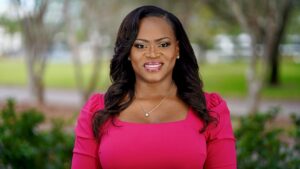
Saundra Weatehrs
From Silhouettes, by Tiffany Razzano
Originally published April 19, 2024
As a high school student, Fort Lauderdale native Saundra Weathers decided on the car ride to tour Florida A&M University that she would study journalism. She wrote for her high school newspaper and had a natural interest in what was going on around her. “I don’t like to say nosy; I like to say curious. I was always very curious. I want to know more,” she said.
That’s how the Spectrum Bay News 9 reporter launched her news career. Admittedly, she wasn’t always a model student. “There’s a saying at FAMU; that it’s FAMU-ly and it truly is a family,” Weathers said. “I had some of my professors rein me in and say, ‘Listen girl, get it together.’”
Initially, she wanted to be an entertainment reporter. But after interviewing some celebrities, she realized she didn’t enjoy it. Then, thanks to one of her professors, she fell in love with hard news.
Weathers worked at FAMU’s radio station and an internship led to her being hired for an on-air television reporting job for WCTV, a CBS affiliate, during her junior year. “By that time there was no stopping me,” she said.
She stayed with the station for a few months after graduating before deciding it was time to move on. “If you know anything about living in a college town after you graduate, you feel so old,” she said. “It was time for me to go.”
“Before I graduated, I naively told my sister I was moving to Atlanta right out of college and getting a job in news,” Weathers said. “That was not true. So I was trying to figure out what was the most realistic path news wise and also near the water I love so much.”
She hoped one day to get to the Tampa Bay area, the largest market in Florida, but first she landed at WBBH, an NBC affiliate in Fort Myers. She worked there for two years covering four counties in Southwest Florida. “I knew I had to make a stop before” getting to Tampa, she said. But Tampa was “the No. 1 in the state. It’s where I wanted to be.”
Once her career hit the five-year mark, Weathers was hired by Spectrum Bay News 9 and she moved to Polk County. “It was very interesting. It’s great for news. You can’t even make it up the stuff that happens there. And there were great people in Polk County,” she said. “There wasn’t a lot to do, but workwise, it was fantastic.”
After about three years, she moved over to the media outlet’s main office in St. Petersburg to work the night shift. “That means covering everything from every single county,” she said. “Wherever the news happens, you go.”
She remained in that role until 2020, when she launched the Justice for All beat for Spectrum, focusing on issues of equity, inclusion and disparities in the wake of the murder of George Floyd, a Black man, at the hands of a white police officer in Minneapolis.
During the protests surrounding Floyd’s murder, Weathers and her boss at the time “had long, hard conversations about the coverage and being intentional,” she said. “After some back and forth, I got the green light. I said, ‘Listen, I want to do these stories and do them in a way that makes a difference.’”
Weathers has always been drawn to social justice stories, but with this current beat, they’re her sole focus.
To start, she made a list of potential story ideas. But it wasn’t long before the stories were coming to her and members of the community were suggesting topics to cover.
One of her early stories focused on the arrests of Black children in the local juvenile justice system and how many were sent to adult prisons compared to children of other races. “The difference was astronomical,” she said.
She also focused on stories about representation in various fields, such as Black male educators. “I looked at the numbers and was astounded,” Weathers said.
She focuses on the good news too, she added.
She’s also been amazed by the action that’s been taken in the community because of her reporting. In one story, she looked at the reading scores of Black students, which were set back even further because of the COVID-19 pandemic.
She recalls Spectrum creating a graphic around these scores that was widely shared on social media. This was gratifying for Weathers as she read the posts that accompanied these shares. The data backed up what many followers already seemed to know anecdotally. “It was like, ‘We’ve been saying this; now there’s the proof,’” she said. “When you have that type of reporting and so much response, it leaves so much opportunity for resolution.”
After that story came out, a number of organizations and individuals created reading programs “to try to close the gap for African American students,” she said, adding that it was “a real catalyst for change and people making a difference.”
Weathers has also reported extensively on Black maternal health, a topic that is “near and dear” to her. After airing a special on the issue last year, she received tremendous feedback from viewers in both the Tampa and Orlando areas.
“After it aired, a woman reached out to me and said, ‘Listen, I lost a child during birth. I already have a nonprofit, but I want to do more. This special was the kick I needed to do more,’” Weathers said.
Months later, the woman called back to say she launched an ongoing series of town hall meetings with health care and nonprofit leaders to discuss how to lower infant and maternal mortality rates in the Black community. “It led to this huge conversation in the Tampa Bay area,” Weathers said.
This year, the University of South Florida is even hosting a series of talks and other events, as well as offering mothers various resources, from April 11-17 for Black Maternal Health Week. “It’s really amazing to see how this conversation is now spreading like wildfire,” she said.
She’s touched by the momentum that stemmed from her stories. “I embrace my humanity in my reporting. I never try to tell a story as a robot. There is always a human behind that and I try to let that come out in my reporting. I’m not biased; I’m human,” she said. “I hope people feel that when they see that, that when they reach out to me, they know that’s coming from a place of someone who wants to help. I do this 100 percent to help people.”
Silhouettes profiles Holly Gregory
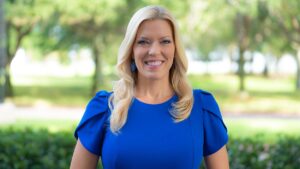
Holly Gregory
From Silhouettes, by Tiffany Razzano
Originally published Jan. 20, 2023
A native Midwesterner, Holly Gregory was born and raised in a small town. “A little bitty town in Illinois that is still exactly the same,” she said.
Her father, who grew up on a farm, was a corrections officer, and her mother, a teacher. “In fact, she was my fifth-grade teacher. That’s how small my town was,” the Bay News 9 evening anchor said. “Everybody knows everybody, and you’re probably related to about a third of them.”
As a child, Gregory didn’t show an early interest in journalism. Instead, she participated in Future Farmers of America. “I didn’t grow up thinking I was going to be a reporter,” she said.
Through the FFA, she became interested in farm reporting and “it evolved from there,” she said. “I’m a communicator and I was like, ‘I can do this. I like being on air.’ At the time, it was very much agriculture based.”
She studied radio and television at Butler University in Indianapolis before moving to New York City for her last two years of college. There, she attended Marymount Manhattan College. “I’d been in the Midwest my whole life and I had no idea what I was in store for,” she added.
Her professors all worked in the field with “great connections” and through one of them, Gregory was able to land an internship with journalist and television host Geraldo Rivera. His office was across the street from the CBS building, where he also filmed. “It was eye opening and interesting and crazy,” she said.
She spent so much time in the CBS building that whenever she had a free moment, she’d walk down to the CBS local news studios and introduce herself to the staff there. “I made some friends – you’d never be able to do that today,” she said. “I found some people to take me under their wing.”
Through these friendships at CBS, staff members helped her put together a professional-looking newscast reel in the studio. “I had this beginner TV tape that was the slickest thing you’ve ever seen in the No. 1 market,” Gregory said. “I’d sit at the desk doing what looks like what is a real report.”
She also worked part time at the New York Post as what was referred to one of “the copy kids.” This was before computers and email were prevalent in the office. “I would run hard copy around to the editors,” she said.
With her experience with the Post and Rivera and her slick demo tape, she applied to entry-level broadcast jobs all over the country, ultimately accepting her first full-time position at WGEM in Quincy, Illinois.
“New York was where I really got the news bug,” she said. “It made me realize this is what I want to do and also that I can’t start on camera in the No. 1 market.”
Gregory spent four years at WGEM before moving on to WHO TV, an NBC affiliate in Des Moines. “That was like reporter bootcamp,” she said. “Our news director, he didn’t pull any punches; you better get it right.”
There, she had the opportunity to cover the Iowa caucus, which is how she “got the bug” for covering politics.
Not a fan of divisive arguing, she quickly established a philosophy that was “a little different from other political reporters,” she said. “I’ve always been a general assignment reporter. I’ve always been more rounded and then I do politics. I’m more like your average person who does politics. My philosophy is to let them talk.”
Then, her husband’s company transferred him to Chicago for “a job he couldn’t turn down,” she said.
This was an opportunity for her to take the next step in her career, as well, but left her with some insecurities. “Am I able to make the job from Des Moines to the No. 3 market in the country?” she said.
For seven months, she knocked “on every door in” Chicago, Gregory said. “I’d talk to anyone who would give me the time of day to get my foot in the door.”
Then, on Christmas Eve, she received a call from a news director at CLTV – what she calls “the Bay News 9 of Chicago at the time.” The station had three staff members call out sick. “They told me, ‘We need somebody,’ and I said, ‘I’m your girl,’” she said.
She spent six years with the station, which eventually sistered with WGN-TV in that market.
“There’s no place like Chicago for covering news. It’s a trip,” Gregory said. “Until I came to Florida. That’s a whole different trip.”
In 2009, her husband was transferred to Tampa. During the family’s first three years in the area, she focused on raising their three young children.
But she missed journalism and knew she wanted to get back into it the field, taking a job as anchor/reporter with Bay News 9. “The rest has just been history here,” she said. “It was a fantastic move here, career wise.”
Since moving to Florida, she’s covered a range of stories that grabbed national attention – from the infamous Casey Anthony. Julie Schenecker and George Zimmerman trials to the Seminole Heights serial killer to the Republican National Convention to Hurricane Michael’s devastating hit to the Panhandle.
“You name any big story over the decade, and we’ve done it,” she said. “With Bay News 9, we go. If there’s a big story in the state, we’re going.”
Hurricane Michael is probably one of the more memorable stories she covered. “I was there for the duration – before, during and after,” Gregory added. “I’ve never done work like that since, as far as hurricane coverage. Calling it ‘unbelievable’ doesn’t do it justice. You just have to be there to see what it’s like. These were real stories and we got to talk to real people.”
She also covered Hurricane Ian’s recent battering of the Fort Myers area. “But after the fact,” she said. “It’s about getting these stories on TV and making people understand what happened.”
Over the past decade, as she’s covered the news, she’s seen firsthand how much the region has grown – “the population and the changing of how Tampa looks and home values,” she said. “When I first came here, everything had a foreclosure sign in front of it, it seemed like. The economics…have changed drastically since I first got here. Now it’s a bigger, more bustling, more developed city.”
Even with all these changes, she still loves her work and can’t imagine being a journalist anywhere else. “There’s still that openness, that certain something you can’t quite put your finger on about covering Florida news,” she said. “Everybody seems to be coming from everywhere else. It’s a melting pot within a melting pot and everyone has a story.”